River Restoration of the Dornbirner Ach and Spirsbach, Vorarlberg
Project description
In Vorarlberg, two rivers will undergo restoration between 2026 and 2029.
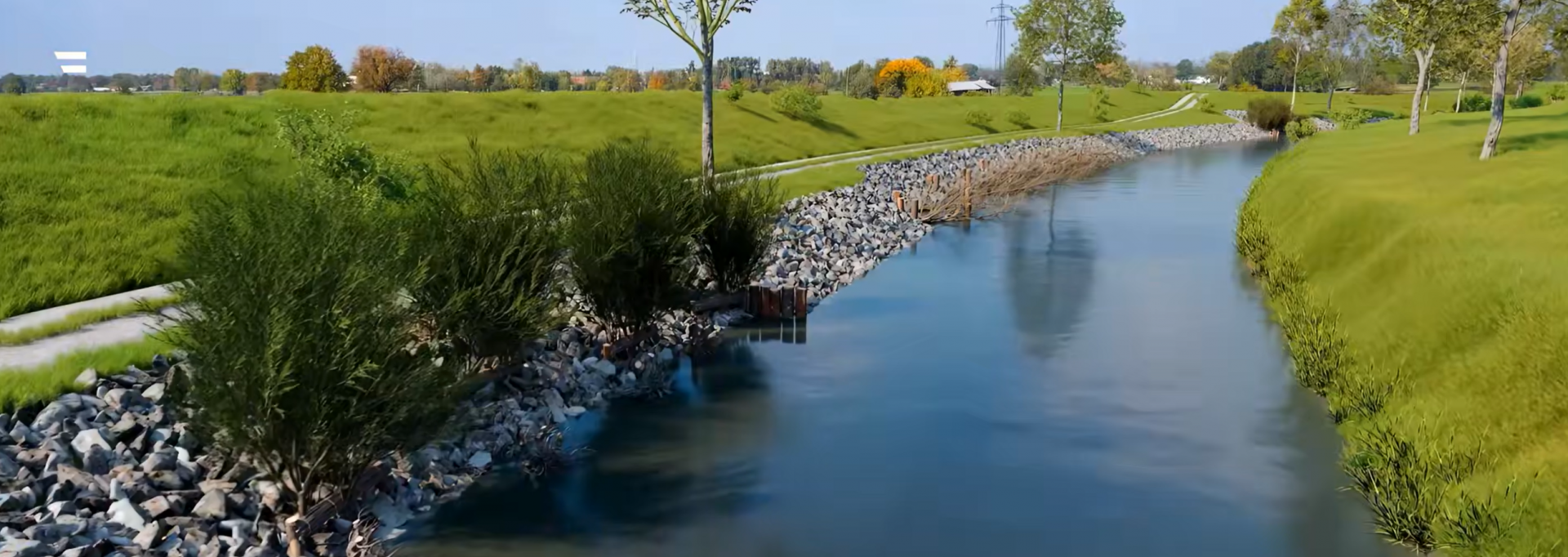
The Dornbirner Ach in Vorarlberg, with a 100-year flood discharge (HQ100) of 298 m³/s, will be restored along a reach of more than 5 kilometres. The river channel will be widened, the banks regraded to gentler slopes, a more natural riverbed will be established, more than 200 trees and 1,000 shrubs will be planted, and bioengineering structures will be installed to create new habitats. The measures designed to increase hydraulic and habitat diversity include island structures with woody elements, so-called “Engineered Log Jams”, as well as fish refuges, scour pools, groynes, fascines, pile rows, bank pile walls, boulders and riprap structures. These measures will sustainably improve the ecological status of the Dornbirner Ach and secure habitats for flora and fauna in the long term. The removal of the existing straightened alignment and the provision of shading to reduce water temperatures are key components of the project.
The restoration project for the Spirsbach stream, extending over more than 1.5 km in the municipality of Feldkirch, is of outstanding ecological importance. The groundwater-fed stream, characterised by relatively warm winter temperatures, serves as one of the few remaining spawning and refuge habitats for fish species of the Alpine Rhine system. The centrepiece of the enhancement programme is the realignment of the stream into historical side channels ('Hechtlöcher') and the initiation of a dynamically meandering channel alignment with varying bank inclinations. Through the targeted installation of bioengineering elements such as large woody debris, root stocks and shaped islands, together with the provision of a continuous gravel bed, a wide range of microhabitats will be created for fish, macroinvertebrates and gravel-spawning species.
Both projects contribute to the sustainable improvement of the ecological status and ecological potential of the water bodies in accordance with the EU Water Framework Directive by creating valuable habitats for aquatic fauna and amphibians through wider, more dynamic channel structures and riparian vegetation.
The Dornbirner Ach in Vorarlberg, with a 100-year flood discharge (HQ100) of 298 m³/s, will be restored along a reach of more than 5 kilometres. The river channel will be widened, the banks regraded to gentler slopes, a more natural riverbed will be established, more than 200 trees and 1,000 shrubs will be planted, and bioengineering structures will be installed to create new habitats. The measures designed to increase hydraulic and habitat diversity include island structures with woody elements, so-called “Engineered Log Jams”, as well as fish refuges, scour pools, groynes, fascines, pile rows, bank pile walls, boulders and riprap structures. These measures will sustainably improve the ecological status of the Dornbirner Ach and secure habitats for flora and fauna in the long term. The removal of the existing straightened alignment and the provision of shading to reduce water temperatures are key components of the project.
The restoration project for the Spirsbach stream, extending over more than 1.5 km in the municipality of Feldkirch, is of outstanding ecological importance. The groundwater-fed stream, characterised by relatively warm winter temperatures, serves as one of the few remaining spawning and refuge habitats for fish species of the Alpine Rhine system. The centrepiece of the enhancement programme is the realignment of the stream into historical side channels ('Hechtlöcher') and the initiation of a dynamically meandering channel alignment with varying bank inclinations. Through the targeted installation of bioengineering elements such as large woody debris, root stocks and shaped islands, together with the provision of a continuous gravel bed, a wide range of microhabitats will be created for fish, macroinvertebrates and gravel-spawning species.
Both projects contribute to the sustainable improvement of the ecological status and ecological potential of the water bodies in accordance with the EU Water Framework Directive by creating valuable habitats for aquatic fauna and amphibians through wider, more dynamic channel structures and riparian vegetation.
Project information
Client
Federal Republic of Austria,
Federal Ministry of Agriculture and Forestry, Climate and Environmental Protection, Regions and Water Management, Federal Water Engineering Administration,
represented by the Province of Vorarlberg
Our services
Lead partner of the consortium, restoration planning
Contact Persons
Dipl.-Ing. Benno Hofer
Dipl.-Ing. Hansjörg Jocher
Project Team
F.Preisig AG (Consortium Partner)
MUP – Philipp Meusburger (Ecology)
UMG – Markus Grabher (Ecology)
Lins Mock GmbH (Safety)
Federal Republic of Austria,
Federal Ministry of Agriculture and Forestry, Climate and Environmental Protection, Regions and Water Management, Federal Water Engineering Administration,
represented by the Province of Vorarlberg
Our services
Lead partner of the consortium, restoration planning
Contact Persons
Dipl.-Ing. Benno Hofer
Dipl.-Ing. Hansjörg Jocher
Project Team
F.Preisig AG (Consortium Partner)
MUP – Philipp Meusburger (Ecology)
UMG – Markus Grabher (Ecology)
Lins Mock GmbH (Safety)
Photocredits
Land Vorarlberg / Wasserwirtschaft